
When to Use It: When you want an immediate GPUpdate or GPUpdate /force; When you want to combine it with another command, such as a Windows Update or a restart. Special thanks to Forrest Smalley of IST for providing content and screen shots for this article. How secure is Windows Remote Desktop? Remote Desktop sessions. 1; Q: When I run Windows PowerShell Invoke-Command on more than 32 remote servers, the command runs only on. This version of Remote Desktop Connection (Terminal Services Client 6.0) can be installed on client computers running Windows Server 2003 Service Pack 1 (SP1) or. A complete Guide on HP UFT(QTP) license. This article goes in detail regarding types of license, remote licenses, LSERVRC files, virtual machines compatibility. Previous versions of Windows limited you to five connections if you were running Home Basic or 10 connections for Home Premium or higher editions. Microsoft Windows, or simply Windows, is a metafamily of graphical operating systems developed, marketed, and sold by Microsoft. It consists of several families of.
Is it true that Windows 7 allows 2. A. Previous versions of Windows limited you to five connections if you were running Home Basic or 1.

Home Premium or higher editions. With Windows 7, all editions support 2. File Services, Print Services, IIS, Internet Connection Sharing, and Telephony.

In this article we will cover the use of Remote Desktop, a tool that once mastered can help you to connect over the network to remote servers to perform maintenance.


If you want to confirm this, just run the winver command, click the Microsoft Software License Terms link, then scroll down to section 3. F, as shown here.
Enable Concurrent Desktop Sessions in Windows. Professional and Ultimate editions of Windows come with a built in Remote Desktop (RDP) feature that allows you to access your machine remotely while away from home or the office.
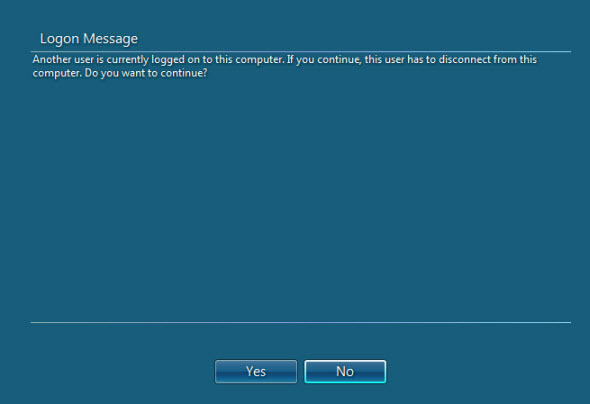
Unfortunately, it is limited by default to one concurrent user per session, meaning that if someone remotely connects to the computer, whoever was logged in at the moment will be automatically logged off, even if the user is physically at the computer. This is not a technical limitation but rather a licensing one. Case in point, Remote Desktop in server editions of Windows by default supports two concurrent connections to remotely troubleshoot or administer a computer. More users can connect simultaneously, too, as long as the machine can handle it with the resources it has available and you have the required client access licenses for that particular server. However, there are a few reasons why concurrent sessions would come in handy for power users not necessarily running a server.
For example, if you have a dedicated Media Center PC running in the living room, you'll be able to remotely access all files on the machine without interrupting the person watching TV. Or if you are sharing a computer with other users, concurrent Remote Desktop sessions will allow more than one person use that system under a different or even the same user account, without kicking each other off. By patching a file called termsrv.
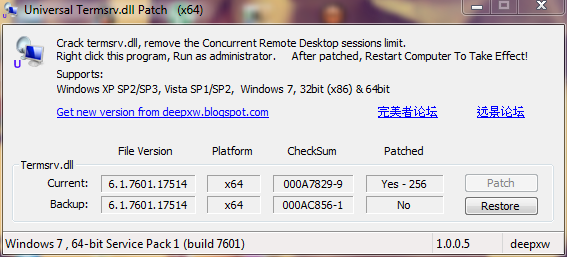
System. Root%System. Windows 7, Windows Vista and Windows XP. Download: Universal. Termsrv. Patch. Simply download and unzip the file, then run the corresponding file as administrator (right- click the exe file and select Run as Administrator).
For 3. 2- bit systems use Universal. Termsrv. Patch- x. Windows use Universal. Termsrv. Patch- x. You should see a window like the one above where you can patch termsrv.
Concurrent Remote Desktop sessions limit and restore the original file at any time (a backup file is located at 'windowssystem. After applying the patch, restart your system and you are ready to go. To test it out simply leave a session open on to the PC where you applied the patch, then from another machine try and connect to the computer remotely. If all goes well both users will be logged on and active.


/http%3A%2F%2Fwww.airfrance.fr%2Fcommon%2Fimage%2Fnouveaux_templates%2Fsalons%2Fsalon_visuel_1.jpg)
/https%3A%2F%2Fmedia-cdn.tripadvisor.com%2Fmedia%2Fphoto-s%2F01%2F47%2F38%2Fec%2Fmujer-de-cachi-salta.jpg)
/http%3A%2F%2Fwww.cracksfiles.com%2Fwp-content%2Fuploads%2F2015%2F01%2FRealtek-Hd-Audio-Codec-Driver-For-Windows-7-64-bit-Full1.jpg)
/http%3A%2F%2Fimg.gimpguru.org%2Fnimg%2F7b%2F0c%2F45e72f4e68aed62da8153029d578-200x200-1%2Fforging_gearbox_strong_style_color_b82220_straight_bevel_strong_gear_for_agriculture_machines_rotary_cutter.jpg)